


If you’re wondering whether "no stuffing squeaky dog toys" actually reduce mess and health risks, the short answer is: they remove one specific hazard (loose polyester stuffing) but do not eliminate all hazards. This guide explains what "no‑stuffing" means, how the risk profile changes, who should buy these toys, how to inspect and retire them safely, and what to choose instead for aggressive chewers.
Quick answer: what no‑stuffing toys do and don’t do
No‑stuffing squeaky plush toys remove inner polyester/foam batting, which reduces the specific risk and mess of stuffing ingestion. They still frequently contain built‑in squeakers or crinkle film and can fail at seams; those hard parts remain possible choking/foreign‑body hazards. Supervision, correct sizing, and prompt removal of damaged toys remain essential (see veterinary guidance below).
What "no‑stuffing" means (construction explained)
Direct answer: "No‑stuffing" or "stuffing‑free" means the toy lacks loose inner polyester or foam batting; it does not guarantee absence of hard parts such as squeakers or crinkle liners.
Supporting explanation:
- Many manufacturers label specific lines as "no‑stuffing" to indicate they removed batting/polyfill from the interior (examples: ZippyPaws Skinny Peltz; Ethical Pet Skinneeez). See the manufacturer's product pages for those lines for primary claims. (ZippyPaws Skinny Peltz; Ethical Pet Skinneeez on Chewy.)
- Typical internal elements still found in many stuffing‑free plush toys: sewn‑in squeakers (rubber/plastic), crinkle film liners, embroidered details, and sometimes extra fabric panels for modest reinforcement. "No stuffing" only refers to the absence of loose soft batting.
- Because construction varies across brands, read the product description for explicit notes about squeakers, crinkle liners, or reinforced seams before assuming a toy is squeaker‑free or extra‑durable.
Safety: evidence and practical risks
Direct answer: Removing stuffing reduces one specific type of ingestion hazard (polyester batting), but stuffing‑free toys still pose risks from hard parts and seam failure; veterinarians and animal welfare organizations continue to recommend supervision and discarding damaged toys.
Supporting explanation and evidence:
- Veterinary guidance: Independent veterinary resources advise that soft stuffing can cause intestinal blockage if ingested and recommend supervising play and discarding damaged toys. See Embark Vet’s toy safety guidance for supervision and discard rules. (Embark Vet – Dog Toy Safety Tips.)
- Clinical incident: The ASPCA has published case reports showing that ingested toys (including non‑stuffing items) can cause life‑threatening intestinal foreign bodies and require emergency treatment. This illustrates that removing stuffing does not remove all ingestion risks. (ASPCA – Ingested toy case.)
- Manufacturer cautions: Product pages for stuffing‑free lines still advise supervised play and warn that toys are not indestructible. That language signals manufacturers recognize residual hazard from squeakers/seams. (See various product listings such as ZippyPaws and KONG on retailer pages.)
How vets say to supervise and when to discard a toy
Direct answer: Inspect toys before and after play; discard at the first sign of seam failure, exposed squeaker, or small pieces coming loose.
Checklist — quick inspection steps (use before and after play):
- Check seams and fabric for fraying or holes.
- Look for exposed or loose squeakers/crinkle film.
- Ensure the toy’s size cannot be fully swallowed or get lodged in the throat.
- If threads, fabric, or hard parts are loose, remove the toy immediately and discard it.
- Rotate toys and never leave plush squeaky toys unsupervised with high‑risk chewers; supervise cuddle/play sessions instead.
Why this matters: veterinary guidance and published clinical incidents show that swallowed hard parts or pieces can cause obstruction or require emergency surgery. Removing stuffing helps, but the remaining elements still require caution. (Embark Vet; ASPCA.)
Durability & who these toys suit
Direct answer: Stuffing‑free plush toys are best suited to light to moderate chewers and dogs whose play primarily involves fetch, shaking, and gentle mouthing. They are not designed for heavy or relentless chewers.
Supporting explanation:
- Manufacturer positioning: Most stuffing‑free plush lines are labeled for light/moderate chewers and include cautionary notes that toys are not indestructible. Buyer reviews and retailer descriptions echo this classification. (See product listings and retail editorial pages for categories of "no stuffing" toys.)
- User patterns: Aggregated retailer reviews commonly show that non‑destructive dogs can enjoy stuffing‑free toys longer than traditional stuffed plush, because the motivating prize (polyfill) is gone. However, determined chewers often still breach seams to access squeakers or tear fabric. (Chewy category: Unstuffed toys.)
- Practical match by chew style:
- Light chewers / cuddle seekers: stuffing‑free plush often works well — lower mess and keeps squeaker play.
- Moderate chewers / playful mouths: may be suitable with supervision and rotation.
- Heavy/aggressive chewers: not recommended — choose durable rubber/nylon chew toys designed to withstand strong chewing.
Alternatives and when to choose them
Direct answer: If your priority is durability against heavy chewing, choose non‑plush chewables (rubber, nylon) or reinforced plush with documented reinforcement; choose stuffing‑free plush when your priority is lower mess and plush play for a light chewer.
| Toy category | Best suited for | Key tradeoff |
|---|---|---|
| Stuffing‑free plush | Light to moderate chewers, cuddle/play | Less mess, still contains squeakers/hard parts — supervise |
| Traditional stuffed plush | Very gentle dogs that won’t disembowel toys | Soft and cuddly but stuffing can create mess and intestinal hazard if ingested |
| Durable rubber/nylon chews | Heavy chewers and power chewers | High durability, less cuddly; different engagement than plush |
If you want a stuffing‑free, high‑value multi‑pack for light/moderate play (crinkle + squeak for engagement), consider the following option.
If your priority is a multi‑pack of no‑stuffing squeaky toys for varied play and testing which style your dog prefers, this 6‑pack offers sample variety and value. At the time this article was prepared, the listed price was $19.99. The listed price can change, so check Amazon for the current price.

Buying checklist: how to pick the right stuffing‑free squeaky toy
Direct answer: Match the toy’s construction and size to your dog’s chew strength and supervise play. Use the short checklist below to choose and maintain safe use.
Checklist (what to prioritize and why):
- Chew strength match: Choose stuffing‑free plush for light/moderate chewers only. Heavy chewers need solid rubber/nylon chews.
- Squeaker and hard parts: Count squeakers and identify crinkle liners in the product description. More hard parts increase potential ingestion hazards.
- Size fit: Pick a size your dog cannot swallow whole; product pages often include size guidance — follow it.
- Seam reinforcement: Look for descriptions mentioning reinforced seams or extra lining; those features can marginally slow seam failure (not chew‑proof).
- Washability: If hygiene is a concern, check whether the toy is machine‑washable or has washable instructions.
- Rotation & inspection plan: Inspect toys before and after play; remove immediately at the first sign of tearing or exposed hard parts.
- Trial approach: Buying a multi‑pack or budget option to test your dog’s interest and durability profile is practical for uncertain buyers.
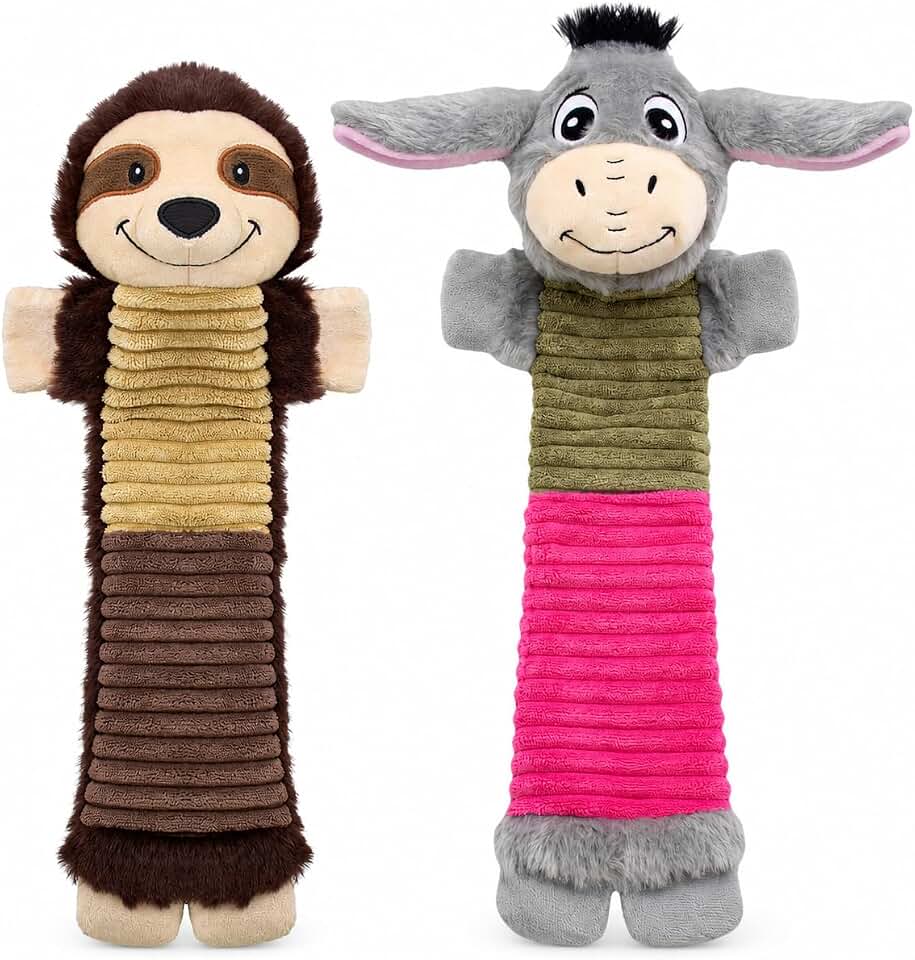
If your priority is a simple, budget-friendly two-pack for early trials or for households that want spare toys at low cost, consider this economical option. At the time this article was prepared, the listed price was $8.99. The listed price can change, so check Amazon for the current price.
Practical guidance for mixed households and heavy chewers
Direct answer: In homes with heavy chewers, separate chew categories: reserve plush squeaky toys for supervised, short‑session play with light chewers; use durable rubber/nylon toys for heavy chewers left unsupervised.
Supporting guidance:
- Mixed household plan: designate plush toys for cuddle/play sessions under supervision. Keep a separate basket of durable chews (e.g., KONG Classic, West Paw Toppl) for unsupervised chewing. This reduces the probability that a heavy chewer will destroy plush and expose hard parts when alone.
- Routine: rotate toys daily; inspect after the first 5–10 minutes of a new toy session to catch early failure points.
- Behavioral alternatives: if your heavy chewer seeks squeak/feedback, consider interactive treat-dispensing toys or durable squeaky alternatives designed for stronger jaws; check product specifications and manufacturer guidance for suggested chew strength.
Product examples and how each fits buyer needs
Below are three representative Amazon listings (used as examples of common stuffing‑free/no‑stuffing style toys). Each is presented with editorial context so you can match to a buyer need. Before the first product card below, note this affiliate disclosure.
Affiliate disclosure: Best Buy Hot Sales Deals may earn a commission from qualifying purchases made through links on this page, at no additional cost to you.
If your priority is a familiar plush look with a stuffing‑free interior for low‑mess cuddle and light play, this 4‑figure small set is a practical option. At the time this article was prepared, the listed price was $12.99. The listed price can change, so check Amazon for the current price.
Why this matters: This card illustrates a typical small, non‑stuffed squeaky plush pack aimed at owners wanting the plush feel with lower household mess. Use for supervised cuddle/play and as a trial item for light chewers.
How to read product pages and labels (translate marketing into safety decisions)
Direct answer: Look for explicit mentions of "no stuffing" plus separate statements about "squeaker(s)", "crinkle", and recommended chew strength. If a page does not mention squeakers, assume they may be present unless explicitly stated otherwise.
Practical steps:
- Scan the product title and description for "no stuffing" / "stuffing‑free" language.
- Search the description for "squeak", "squeaker", "crinkle", "reinforced", "lined", or "machine‑washable". Each term indicates important internal features.
- Read the "intended chew strength" or "not indestructible" caution — these phrases indicate limited suitability for strong chewers.
- Check customer photos and the Q&A/reviews for repeated seam failure comments; reviewers often reveal common failure modes not visible in official specs.
Inspecting, retiring, and safe play — a practical schedule
Direct answer: Inspect on every rotate/first play; retire at first sign of torn fabric, loose threads, exposed squeaker, or small pieces.
Inspection schedule suggestion (practical):
- Before first use: look for hidden parts, count squeakers, pick a suitable size.
- First five minutes of play with a new toy: watch closely for seam failures or rapid disintegration.
- After each supervised session: check seams, fabric, and hard parts; discard if any damage is found.
- For unsupervised periods: do not leave plush squeak toys with dogs known to chew aggressively — even stuffing‑free varieties can fail.
Rationale: Vet guidance and case reports show that early detection of toy failure stops small pieces or hard parts from becoming ingestion hazards. (Embark Vet; ASPCA.)
FAQ
Do no‑stuffing toys eliminate the risk of intestinal blockage?
No. They remove the specific hazard of loose polyester stuffing, which can cause blockages, but squeakers and crinkle film remain possible ingestion hazards. Supervise play and discard damaged toys immediately. (See Embark Vet toy safety guidance.)
Are stuffing‑free squeaky plush toys safe for heavy chewers?
Generally no. Most stuffing‑free plush toys are labeled for light to moderate chewers and are not chew‑proof. For heavy chewers, choose durable rubber or nylon chew toys designed for strong jaws.
How should I choose the right size?
Choose a toy that cannot be swallowed whole by your dog. Product pages usually include size guidance; when in doubt, pick the next larger size so the toy cannot become lodged in the throat.
How often should I replace a squeaky plush toy?
Replace it at the first sign of seam failure, exposed squeaker, small bits, or fraying. There is no universal interval; inspection after each play session is the safest practice.
Is a toy labeled "no stuffing" the same as "reinforced"?
No. "No stuffing" means there is no inner batting; "reinforced" typically refers to stronger seams or extra lining. Some products may be both, but treat them as separate claims and verify in the product description.
Can I machine wash stuffing‑free plush toys?
It varies by product. Some plush lines are machine‑washable; others recommend surface cleaning only. Check the manufacturer’s care instructions on the product page.
Are multi‑packs a good way to test my dog's response?
Yes. Multi‑packs let you test different shapes and features (squeak vs crinkle) to see what engages your dog before committing to more expensive single items. Use supervised trial sessions to evaluate durability.
If a squeaker is exposed, can I remove it and keep the toy?
Only if removal leaves no small hard or sharp parts and the remaining toy has no loose pieces. Many vets advise discarding any toy from which the squeaker becomes exposed because the structural integrity is compromised.
Do stuffing‑free toys reduce household mess?
Yes — many owners report less polyfill mess because the toy lacks loose stuffing. That said, fabric fibers and small bits can still appear if seams fail, so supervision and inspection still matter.
Where can I find more authoritative safety guidelines?
Consult veterinary resources such as Embark Vet and nonprofit guidance from national animal welfare organizations for toy safety best practices and emergency information. (Embark Vet; HumaneWorld safe toy guide.)
Conclusion — how to decide and next steps
Summary: "No‑stuffing" squeaky plush toys reduce the mess and the specific hazard of loose stuffing, making them a reasonable option for many light to moderate chewers. They do not remove the risk of ingestion entirely because squeakers and crinkle liners remain potential hazards; supervision, correct sizing, and prompt disposal of damaged toys are essential. For heavy chewers, prefer durable chew toys designed for intense chewing.
Next steps:
- Use the buying checklist above to select a toy that matches your dog’s chew style.
- Try a multi‑pack or budget two‑pack for initial trials (as noted in the product examples above).
- Inspect toys before and after play and remove at the first sign of damage.
- Check the current retailer listing for the latest price and availability before purchasing.
Check current listings: Use the product links in this article to view the most recent product details and prices on Amazon. Best Buy Hot Sales Deals may earn a commission from qualifying purchases through those links at no additional cost to you.
Research and safety sources referenced in this article include manufacturer product pages (ZippyPaws, Ethical Pet, West Paw), retailer category listings (Chewy), veterinary guidance (Embark Vet), and nonprofit clinical reporting (ASPCA). All sources were checked during research on 2026‑09‑29; product prices and availability can change, so verify the current listing before buying.






0 Comments