


The right chew toys soothe teething, reduce destructive chewing, and give your puppy safe stimulation—if you match material and size to your puppy’s age and chew strength. This guide explains which materials vets and animal‑welfare organizations recommend, how to size and inspect toys, and practical steps to reduce choking, obstruction, and tooth‑fracture risk when choosing safe puppy chew toys.
Quick answer — 3 safety rules and a starter toy
Quick answer: For most puppies, start with a puppy‑formulated soft rubber chew (designed to flex and soothe gums), size it so no part can be swallowed, and always supervise first sessions. Avoid giving very hard chews (antlers, large bones) to puppies because they can chip teeth and create dangerous fragments. For teething relief, manufacturers and veterinarians commonly recommend a puppy rubber toy you can stuff and freeze (see KONG guidance and veterinary sources below).
- Size: pick a toy too large to swallow; when in doubt, size up (KONG sizing guidance).
- Material: choose puppy‑formulated soft rubber or supervised edible chews; avoid very hard chews for puppies (VCA Hospitals).
- Supervise & retire: watch initial use, discard if pieces break off, and replace damaged toys promptly (ASPCA).
Why puppies chew (and what that means for toy choice)
Puppies chew for two main reasons: teething discomfort when baby teeth erupt and fall out, and natural exploratory/occupational behavior. Chew toys that provide a soft, compressible surface soothe gums and redirect destructive chewing toward a safe object. Manufacturer guidance for puppy‑formulated toys (for example, KONG’s Puppy line) explicitly recommends stuffing and freezing some toys to ease teething, and veterinary sources advise choosing softer materials for young dogs to reduce tooth damage risk (KONG; VCA Hospitals).
Materials explained — safest choices and those to avoid
This section explains common chew materials, when they are appropriate for puppies, and the main risks to watch for. Each material summary notes the source of the guidance.
Soft puppy‑formulated rubber (recommended starter choice)
Why buyers choose it: Puppy‑formulated rubbers are intentionally softer than adult‑grade rubbers so they compress under a puppy’s bite and soothe gums. Manufacturer guidance for products labeled “Puppy” (for example, KONG Puppy) describes stuffing and freezing options to relieve teething discomfort. Veterinary sources commonly recommend soft rubber as a safe first option for teething puppies (KONG; VCA Hospitals).
Durable rubber / proprietary non‑toxic materials (for later or supervised sessions)
Why buyers choose it: Brands that make extra‑durable rubber or thermoplastic rubbers (e.g., West Paw Zogoflex) are useful when a puppy’s chewing strength increases. Manufacturer pages emphasize durability and non‑toxic materials; however, veterinary advice still recommends matching hardness to age and supervising younger puppies because very durable formulations can be too hard for developing teeth (educational sources).
Nylon and shaped chews (e.g., wishbones or durable chews)
Use with caution: Many nylon chews are long‑lasting but can be very hard. Veterinary guidance warns that very hard chews—regardless of brand—can chip or fracture puppy teeth, so avoid hard nylon for very young puppies or only use under strict supervision once adult teeth begin to come in (VCA Hospitals).
Edible chews (bully sticks, pressed rawhide, Himalayan chews)
What to know: Edible chews vary widely. Animal welfare and veterinary organizations note rawhide can fragment into large pieces that swallowers may choke on or that can cause intestinal obstruction; some rawhide’s digestibility is variable and dependent on processing. Bully sticks are generally digestible for many dogs but are calorie‑dense and can still present choking risks if large pieces break off. The AKC and ASPCA advise supervision for edible chews and caution about rawhide in particular (AKC; ASPCA; see also an in‑vitro study on rawhide digestibility for context: de Godoy et al., PMC).
Antlers, large hard bones, hooves
Why to avoid for puppies: Vets commonly warn that very hard natural chews (antlers, large weight‑bearing bones) can fracture teeth—this is a documented clinical concern. These items are typically not suitable for puppies with developing dentition (VCA Hospitals).
Plush and rope toys
Use-case: Soft, comforting and useful for light chewing and play. Risk: stuffing and squeakers can be ingested if seams are breached. Choose double‑stitched, heavy‑duty plush for puppies and supervise initial sessions; discard immediately if stuffing or small parts are exposed (VCA Hospitals).
Sizing, inspection, and retirement rules — a practical safety checklist
Follow these steps every time you buy or inspect a chew toy for a puppy:
- Size test: No part of the toy should fit entirely inside your puppy’s mouth. When in doubt, choose the next size up. This follows manufacturer sizing guidance (for example, KONG) and veterinary recommendations (VCA Hospitals).
- Indentation test: Puppy‑formulated rubbers should give slightly under your thumbnail; if the toy is rock hard and won’t indent, it may be too hard for young teeth (veterinary guidance).
- First‑use supervision: Watch the puppy for the first 10–15 minutes of play to see if pieces break off or the puppy can remove stuffing/small parts (ASPCA).
- Inspect regularly: Check for tears, exposed cores or loose parts before each session; discard and replace if the toy is compromised. Some manufacturers (e.g., GoughNuts) advertise chew indicators to show when to retire a toy—this is a manufacturer feature and should be considered a helpful tool, not a substitute for regular inspection (educational summary).
- Hygiene: Wash rubber and silicone toys per manufacturer instructions to reduce bacterial buildup; edible chews should be given in moderation and under supervision.
Affiliate disclosure: Best Buy Hot Sales Deals may earn a commission from qualifying purchases made through links on this page, at no additional cost to you.
If your priority is a puppy‑formulated, stuffable teething toy that’s designed to be softer than adult formulations, this option is worth considering because the manufacturer states it’s made for puppies and recommends stuffing/freeze use for teething relief.
```
Note: The manufacturer states the KONG Puppy formulation is designed for younger dogs and can be stuffed or frozen to soothe gums. For manufacturer details see the KONG company guidance. At the time this article was prepared, the listed price for this item was $6.46 — check the current listing for the latest price and availability.
Dental chews and the VOHC seal — what that actually means
The Veterinary Oral Health Council (VOHC) awards a Seal to specific products that have submitted clinical trial data showing a meaningful reduction in plaque and/or tartar under specified test conditions. VOHC acceptance is an evidence‑based indicator of dental efficacy for the tested claim, but it does not guarantee the mechanical safety of a chew for every puppy or scenario. Use VOHC‑accepted chews as an adjunct to brushing and regular veterinary dental checks, not a replacement for brushing when recommended by your vet (VOHC; PetMD).
Practical recommendations by puppy archetype (what to buy now)
Use these pragmatic shopping lists to assemble a starter set tailored to your puppy’s likely chew strength. These recommendations follow the material and sizing guidance from manufacturers and veterinary sources cited above.
1) Small breed / light chewer (8–16 weeks)
- Primary toy: puppy‑formulated soft rubber (small size) — for stuffing/freeze use to soothe teething (KONG).
- Secondary: heavy‑duty double‑stitched plush for supervised play.
- Edible option (supervised): a small, single‑ingredient chew given in short sessions; avoid rawhide unsupervised (ASPCA).
2) Moderate chewer, medium breed
- Primary toy: puppy rubber (medium), rotate a few chew items to reduce wear.
- Supplement: VOHC‑accepted dental chew as directed if your vet recommends an adjunct (see VOHC accepted products).
- Supervision: give more durable chew sessions under supervision; retire damaged toys promptly.
3) Strong chewer, large breed (early stage)
- Primary approach: stick to puppy‑formulated rubbers while teeth are developing; consult your veterinarian before moving to very hard chew types (nylon, antlers) because of tooth fracture risk (VCA Hospitals).
- Consider higher‑durability items for supervised sessions only; use manufacturer safety features (e.g., chew indicators) as a supplement to regular inspection.
Comparison table: representative options
At the time this article was prepared, listed prices in the retailer data supplied were recorded below. Prices and ratings can change — check the current listing for the latest price and availability.
| Product | Best suited for | Key characteristic | Rating (supplied) | Listed price (captured data) | Important consideration |
|---|---|---|---|---|---|
| KONG Ring (Puppy formulation example) | Puppy teething, light–moderate chewers | Puppy‑formulated soft rubber; stuffable/freezeable (manufacturer claim) | 4.5 | $6.46 (listed price at time article was prepared) | Manufacturer recommends sizing guidance; supervise initial use (KONG). |
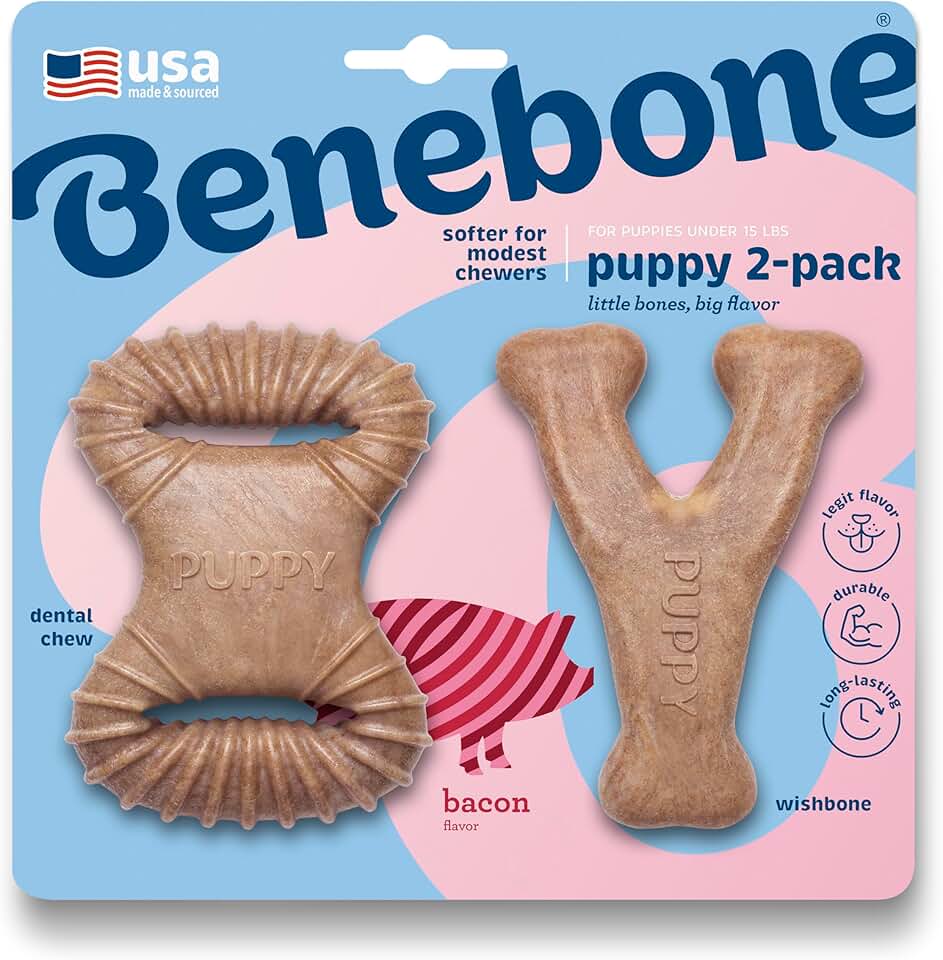
| Benebone Puppy 2‑Pack (title indicates 'Real Bacon') | Buyers wanting flavored chew options for puppies | Sold as dental/teething wishbone with flavor (product title) | 4.5 | $14.20 (listed price at time article was prepared) | Check size and supervise; avoid very hard chews for young teeth. |
| Beiker 20 Pack Puppy Chew Toys (multi‑pack) | Owners who want multiple inexpensive replacements for small puppies | Multi‑pack of small puppy chew toys (product title) | 4.3 | $20.97 (listed price at time article was prepared) | Multi‑packs provide rotation options; inspect each piece for breakage before use. |
Alternatives and where the three supplied products fit
If you want multiple short sessions and frequent replacement (for rotating or crate enrichment), a multi‑pack of small chew toys can be practical because you can rotate items and discard worn pieces quickly. If your priority is a puppy‑formulated single toy for teething relief and stuffing, a KONG Puppy‑formulation ring is a practical first buy (manufacturer guidance). If you prefer flavored wishbone‑style chews marketed for puppies, the supplied Benebone Puppy 2‑Pack is presented as a puppy dental/teething product in its title; verify size and supervise use.
If your priority is flavored or shaped chew options for a puppy that mouths a lot, consider the Benebone Puppy 2‑Pack because the product title indicates “Real Bacon” flavor and it is marketed for teething/dental use. Verify the size is appropriate for your pup before allowing unsupervised sessions.
 ```
```
At the time this article was prepared, the listed price for this Benebone Puppy 2‑Pack was $14.20 — check the current listing for the latest price and availability. The product title indicates a “Real Bacon” flavor; evaluate whether the shape and size are right for your puppy before unsupervised use.
When multi‑packs make sense (and a late recommendation)
If you prefer to have backup toys for crate time, training rewards, or to replace shredded items quickly, a multi‑pack of small puppy chew toys can reduce trips to the store. These packs can be useful for owners of small breeds or households with multiple puppies — inspect each item prior to use and retire any piece that frays or exposes an inner core.
 ```
```
The supplied listing showed a listed price of $20.97 at the time this article was prepared — please check the current listing for price and availability. Multi‑pack buyers should be prepared to discard pieces that become compromised and should supervise initial interactions.
Common mistakes owners make (and how to avoid them)
- Buying a toy that’s too small: small toys or parts can be swallowed. Always perform the size test and favor larger sizes for growing pups (KONG).
- Assuming “durable” equals safe for puppies: durable materials may be too hard and risk fracturing teeth; match hardness to age (VCA Hospitals).
- Leaving edible chews unsupervised: edible chews can fragment; supervise and limit portion size (ASPCA).
- Waiting too long to retire a toy: remove toys with exposed cores, torn fabric, or missing parts immediately (manufacturer indicator features can help but do not replace inspection).
FAQ — focused, citation‑backed answers
Which chew toys are safe for teething puppies?
Soft, puppy‑formulated rubber toys designed to compress under a puppy’s bite and that can be stuffed or frozen are commonly recommended for teething. Veterinary sources endorse softer rubbers to reduce tooth stress; follow manufacturer sizing guidance and supervise initial sessions (KONG; VCA Hospitals).
Are rawhide chews safe for puppies?
Rawhide safety is variable. The AKC and ASPCA warn rawhide can break into large pieces that cause choking or intestinal blockage; many veterinarians advise avoiding rawhide for unsupervised puppies and recommend close supervision or alternative chews (AKC; ASPCA).
Can chew toys damage puppy teeth?
Yes. Very hard chews (antlers, large weight‑bearing bones, some hard nylons) can chip or fracture puppy teeth. Veterinary guidance recommends selecting softer, puppy‑appropriate materials during the teething phase and consulting a veterinarian before introducing very hard chews (VCA Hospitals).
How do I know what size chew toy to buy?
Size so no part of the toy can fit entirely inside the puppy’s mouth. Manufacturer guidance (for example, KONG) suggests sizing up if unsure. Observe your puppy during the first play session to confirm the toy cannot be swallowed whole (KONG).
What does the VOHC seal mean for dental chews?
The VOHC Seal indicates the specific product submitted clinical trial evidence showing a reduction in plaque and/or tartar under VOHC protocols. It is a claim about dental efficacy, not a blanket endorsement of mechanical safety; always confirm the product’s size and suitability for your puppy (VOHC).
How often should I inspect and clean chew toys?
Inspect toys before and after play sessions. Rubber and silicone toys should be washed per manufacturer instructions; plush toys should be checked for tears and laundered according to label guidance. Discard toys with exposed cores, torn seams, or detached parts immediately (VCA Hospitals).
Are antlers safe for puppies?
Generally avoid antlers for puppies. Veterinary sources warn that antlers and very hard natural chews can fracture developing teeth and are therefore not recommended for most puppies (VCA Hospitals).
Can dental chews replace brushing?
No. While some VOHC‑accepted chews reduce plaque or tartar accumulation in clinical trials, they are an adjunct to—not a replacement for—regular toothbrushing when brushing is recommended by your veterinarian (VOHC; PetMD).
What should I do if my puppy swallows a piece of toy?
If you suspect ingestion of a large piece or your puppy shows signs of distress (vomiting, prolonged gagging, abdominal pain, lethargy), contact your veterinarian or an emergency clinic immediately. Intestinal obstruction can become an emergency requiring surgery (clinical context on foreign body risks).
Quick buying checklist (one page, evidence‑tagged)
- Choose a puppy‑formulated soft rubber toy first for teething relief (manufacturer guidance; KONG).
- Size so no part can fit fully in the puppy’s mouth; when in doubt, size up (veterinary & manufacturer guidance; VCA).
- Avoid very hard chews (antlers, large bones) while teeth are developing (veterinary advice; VCA).
- Supervise initial use and every session for edible chews; discard if pieces break off (AKC; ASPCA).
- Use VOHC‑accepted dental chews only as an adjunct to brushing if your vet recommends them; check VOHC’s accepted list for specifics.
- Inspect toys before/after play; retire toys that show exposed cores, large tears, or loose parts (ASPCA; veterinary guidance).
When you’re ready to purchase a recommended starter item or compare current SKUs and sizes, check the product listings for the latest price and availability. For convenience, here are direct product listings (retailer prices vary):
- KONG Ring — View on Amazon
- Benebone Puppy 2‑Pack — View on Amazon
- Beiker 20 Pack Puppy Chew Toys — View on Amazon
Conclusion — a safer starting point for puppy chews
Start with puppy‑formulated soft rubber toys, follow the sizing and inspection checklist, supervise edible chews, and retire any toy that becomes compromised. Manufacturer guidance (e.g., KONG) and veterinary authorities (VCA Hospitals, AKC, ASPCA) agree on these core precautions. Where a product carries a VOHC dental claim, understand that the Seal applies only to that product’s plaque/tartar claim and does not substitute for safe sizing and supervision (VOHC).
If you have specific concerns about your puppy’s chewing behavior, dental health, or a particular toy, consult your veterinarian before introducing harder chew items or edible chews for unsupervised sessions.






0 Comments